
Product Data Reference
Reference for product identifiers, joins, feature flags, listing quality, competitor detection, pricing, and offer tables.
Use this page when you need to query product-level DataHawk data or join product tables together. For conceptual explanations, start with DataHawk Data Concepts.
Identifier fields
| Field name | Description | Where it appears |
|---|---|---|
ASIN | Amazon Standard Identification Number | Product-level Amazon tables |
PARENT_ASIN | Groups child ASINs into a product family | PRODUCT.*, sales estimates tables |
CHILD_ASIN | Specific purchasable variant | Sales-estimate and variant-level tables |
SKU | Seller-defined identifier | Private data tables such as orders, inventory, and COGS |
PRODUCT_KEY | DataHawk internal product identifier | Curated product and report tables |
MARKETPLACE_KEY | DataHawk marketplace identifier | Most marketplace-scoped tables |
MARKETPLACE_ID | Amazon's numeric marketplace identifier | Amazon source and reporting tables |
BSR | Best Seller Rank within a category | Product history, category, and report tables |
Product detail feature flags
PRODUCT.PRODUCT_DETAILED stores product-page attributes collected from tracked products. The FEATURES column lists activated page features detected for a product.
For Walmart products, FEATURES can include:
| Value | Meaning |
|---|---|
about_the_brand | The Walmart product page has an active About the Brand section through its marketing module |
This value appears only when DataHawk detects the feature on the page. If the section is not active or not detected, about_the_brand is absent from the FEATURES list.
Parent and child ASIN joins
When joining product tables, confirm whether the table is parent-level, child-level, or mixed.
PRODUCT.PRODUCT_LISTINGcontains one row per ASIN, which may be a parent or child.- To get all children of a parent, filter where
PARENT_ASIN = '<your_parent_asin>'andASIN != PARENT_ASIN. - Some visibility tables are parent-oriented, while sales and inventory often need child or SKU granularity.
- When joining public product data to private Seller data, use the ASIN/SKU mapping available in private account tables or curated report tables.
Listing quality tables
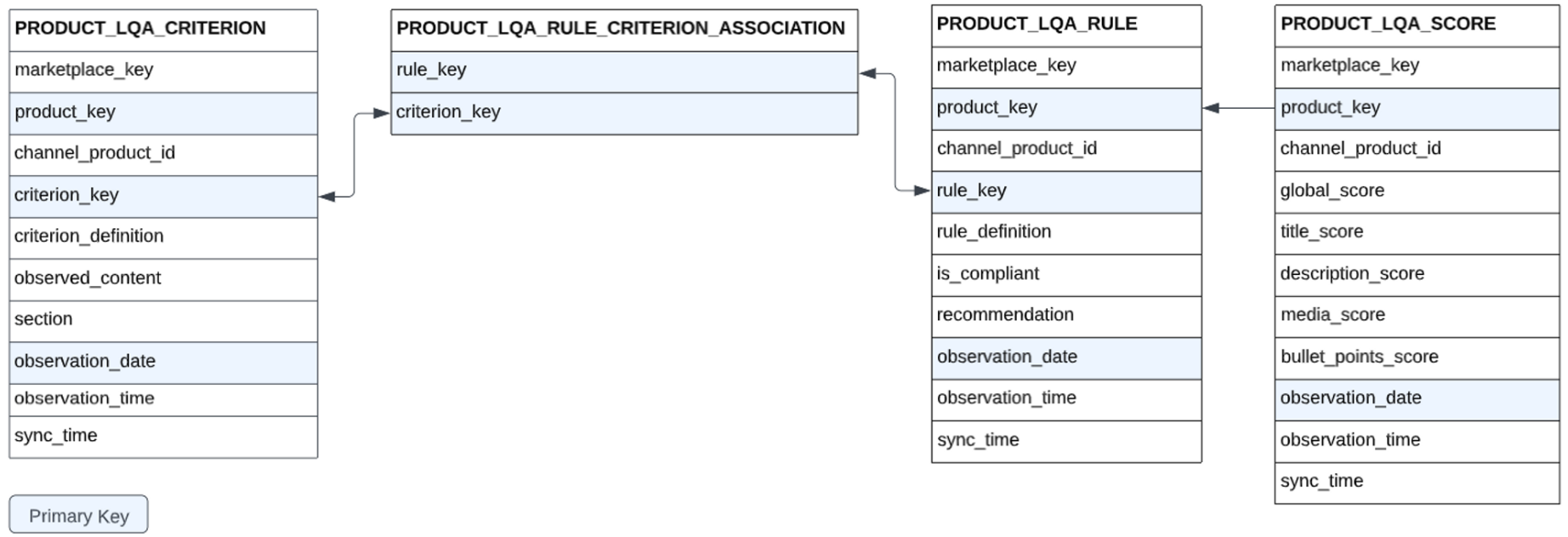
Listing Quality Analysis data lives in the PRODUCT schema and refreshes daily.
| Table | Contents | Key fields |
|---|---|---|
PRODUCT_LQA_CRITERION | Raw listing metrics | product_key, criterion_key, date |
PRODUCT_LQA_RULE | Rule compliance status | product_key, rule_key, date |
PRODUCT_LQA_SCORE | Calculated quality scores | product_key, date |
PRODUCT_LQA_RULE_CRITERION_ASSOCIATION | Rule-to-criterion mapping | rule_key, criterion_key |
Null and empty values
- Null value: DataHawk could not extract this data, so the state is unknown.
- Empty value: DataHawk confirmed the characteristic is absent. For example, an empty "Emojis in title" field means no emojis were found.
Score formula
Section score = sum(rule_compliances * rule_weights) / max_section_points
Global LQS = (Title Score * 0.4) + (Media Score * 0.3) + (Bullets Score * 0.2) + (Description Score * 0.1)
Listing issues (compliance & catalog problems)
Amazon flags catalog and compliance problems on your listings through the Listings Items API: search-suppressed active listings, inactive listings missing an offer or price, items pending approval, and more. DataHawk captures these in SELLING_PARTNER.LISTING_ITEMS.
Released June 2026. This is a raw table today, with no dedicated view or dashboard yet — query it directly using the recipe below. See the changelog entry for what's planned next.
Where the data comes from: LISTING_ITEM_DETAILS:issues is a semi-structured array on each listing item, one entry per open issue, with a code, severity, message, categories, and attributeNames. A single SKU can have multiple issues open at once.
Recipe: current listing issues per SKU
WITH ranked AS (
    SELECT
        WORKSPACE_ID,
        ACCOUNT_KEY,
        SELLER_NAME,
        MARKETPLACE_KEY,
        SKU,
        ASIN,
        ITEM_NAME,
        EXTRACT_TIME,
        issue.value:code::STRING AS ISSUE_CODE,
        issue.value:severity::STRING AS ISSUE_SEVERITY,
        issue.value:message::STRING AS ISSUE_MESSAGE,
        issue.value:categories::ARRAY AS ISSUE_CATEGORIES,
        issue.value:attributeNames::ARRAY AS ISSUE_ATTRIBUTE_NAMES,
        ROW_NUMBER() OVER (
            PARTITION BY ACCOUNT_KEY, MARKETPLACE_KEY, SKU, issue.value:code::STRING
            ORDER BY EXTRACT_TIME DESC
        ) AS rn
    FROM SELLING_PARTNER.LISTING_ITEMS,
        LATERAL FLATTEN(input => LISTING_ITEM_DETAILS:issues) AS issue
    WHERE ARRAY_SIZE(LISTING_ITEM_DETAILS:issues) > 0
      AND EXTRACT_TIME >= DATEADD('day', -3, CURRENT_TIMESTAMP())
)
SELECT
    WORKSPACE_ID, ACCOUNT_KEY, SELLER_NAME, MARKETPLACE_KEY, SKU, ASIN, ITEM_NAME, EXTRACT_TIME,
    ISSUE_CODE, ISSUE_SEVERITY, ISSUE_MESSAGE, ISSUE_CATEGORIES, ISSUE_ATTRIBUTE_NAMES
FROM ranked
WHERE rn = 1
This dedupes to the latest snapshot of each open issue per SKU, so you don't see the same issue repeated across days. The -3 days window only controls which snapshot the dedup uses as "current" — widen it if a SKU's most recent snapshot is older than that.
This returns every issue Amazon reports, not just compliance problems. If you only want catalog/compliance issues (for example, to exclude Out of Stock, which is usually managed elsewhere), filter ISSUE_CODE, ISSUE_MESSAGE, or ISSUE_CATEGORIES to the types you care about. Amazon's own Manage All Inventory > Activate Listings > Fix Issues view in Seller Central groups these; issue types customers commonly ask to track are Search Suppressed, Detail Page Removed, Missing Offer, Pricing Issue, Approval Required, and Closed.
Known gap (as of June 2026): no "date issue first appeared" field. EXTRACT_TIME is when DataHawk captured the snapshot, not when Amazon created the issue, so this table alone can't tell a brand-new problem from one that's been open for weeks. [TO CONFIRM: whether a first-seen timestamp is planned]
Competitor detection table
| Schema | Table | Description |
|---|---|---|
PRODUCT | PRODUCT_COMPETITORS | Competitor products for owned ASINs detected from product, category, price, keyword, and co-occurrence signals |
DataHawk scores candidate competitor pairs using signals such as semantic title similarity, price comparison, shared category depth, keyword intersection, and co-occurrence on listing and search pages. Pairs must reach a 90% confidence threshold to be included.
Pricing and offers tables
| Table | What it contains |
|---|---|
PRODUCT.AMZN_PRODUCT_FEATURED_OFFER | Daily featured offer (Buy Box) snapshot per ASIN |
PRODUCT.AMZN_PRODUCT_COMPETITIVE_PRICES | Amazon competitive-price and was-price benchmarks |
AMZN_PRODUCT_COMPETITIVE_PRICES is sourced from SP-API Product Pricing v2022-05-01 (getCompetitiveSummary). It refreshes daily for tracked products and seller listings, and quarterly for other products connected to DataHawk.
AMZN_PRODUCT_FEATURED_OFFER columns
| Column | Description | Status |
|---|---|---|
OBSERVATION_DATE | Date of the snapshot | Live |
OBSERVATION_TIME | Time of the snapshot | Live |
MARKETPLACE_KEY | Marketplace identifier | Live |
ASIN | Amazon Standard Identification Number | Live |
HAS_FEATURED_OFFER | Whether the listing has a featured offer (Buy Box) | Live |
IS_FEATURED_OFFER_SUPPRESSED | Whether the featured offer is suppressed | Live |
FEATURED_LANDED_PRICE | Total price including shipping for the featured offer | Live |
FEATURED_LISTING_PRICE | Listed price for the featured offer | Live |
FEATURED_SHIPPING_PRICE | Shipping price for the featured offer | Live |
FEATURED_CURRENCY_CODE | Currency of the featured offer price | Live |
FEATURED_ITEM_CONDITION | Condition of the featured offer item | Live |
FEATURED_FULFILLMENT_TYPE | Fulfillment type of the featured offer (FBA/FBM) | Live |
FEATURED_SELLER_ID | Seller ID of the featured offer holder | Live |
FEATURED_SELLER_NAME | Name of the featured offer seller | Coming soon |
FEATURED_SELLER_FEEDBACK_COUNT | Feedback count for the featured offer seller | Coming soon |
FEATURED_SELLER_POSITIVE_FEEDBACK_RATING | Positive feedback rating for the featured offer seller | Coming soon |
TOTAL_FEATURED_OFFERS_COUNT | Total number of featured offers on the listing | Live |
TOTAL_OFFERS_COUNT | Total number of all offers, new and used | Live |
TOTAL_OFFERS_NEW_COUNT | Number of new-condition offers | Live |
TOTAL_OFFERS_USED_COUNT | Number of used-condition offers | Live |
TOTAL_OFFERS_FBA_COUNT | Number of FBA offers | Live |
TOTAL_OFFERS_FBM_COUNT | Number of FBM offers | Live |