
Amazon Inventory Data
Guide to Amazon inventory datasets in DataHawk; FBA planning, ledger detail, restock recommendations, and SQL examples for common inventory questions.
This guide explains Amazon inventory datasets for tracking stock, resolving discrepancies, and optimizing replenishment.
View Your Inventory at the Country Level
If your goal is simply to see your ASIN/SKU inventory the same way Seller Central shows it, use:
- FBA →
SELLER_INVENTORY_FBA_PLANNING_LATEST: FBA qty with AI-driven recommendations for aged stock and removals - FBM →
SELLER_INVENTORY_ALL_LISTINGS: Your catalog with pricing and availability for MFN - Both channels side by side →
SELLER_INVENTORY: One row per ASIN × SKU × Marketplace, blending FBA and FBM stock, price, and condition
These tables show your day-to-day inventory quantities at the country level with key fields: stock, aging, health, and availability.
Decision Flowchart
This diagram acts as a decision tree to identify which inventory tables address your specific needs. Start with your question (e.g. "What's my current stock?" or "Why did inventory change?") and follow the branches to locate datasets for real-time snapshots, historical trends, restock alerts, or logistics planning.
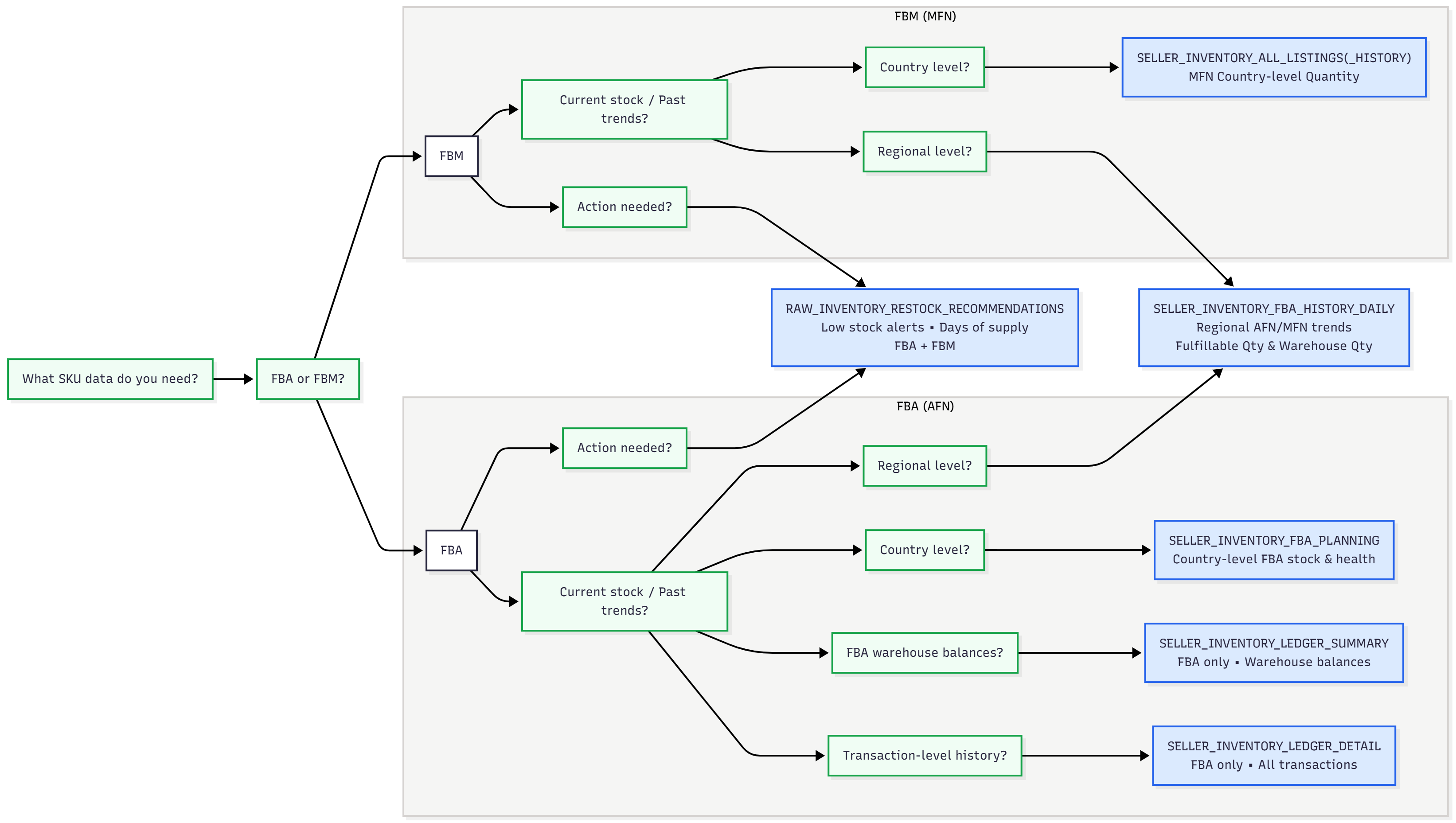
Inventory Datasets
All tables live in either the RAW_INVENTORY or SELLING_PARTNER schema (noted per table below).
Start here — covers most questions
| Schema | View | Purpose | Freshness | Coverage |
|---|---|---|---|---|
SELLING_PARTNER | SELLER_INVENTORY_FBA_PLANNING_LATEST | FBA stock, aging, pricing/removal recommendations | Daily | All marketplaces except NL, PL, SE, BE |
SELLING_PARTNER | SELLER_INVENTORY_ALL_LISTINGS | FBM price, status, quantity | Daily | All marketplaces |
SELLING_PARTNER | SELLER_INVENTORY | Unified FBA + FBM view — combined stock, price, and condition per ASIN/SKU | Daily | FBA side excludes NL, PL, SE, BE; FBM side all marketplaces |
SELLER_INVENTORY doesn't add new data — it joins SELLER_INVENTORY_FBA_PLANNING_LATEST and SELLER_INVENTORY_ALL_LISTINGS on ASIN × SKU × Marketplace so you don't have to. Use the individual tables above if you only need one channel or want FBA-specific fields like aging or reserved detail not exposed on the unified view.
For specific needs
| Schema | View | Use it for | Why not the default? | Freshness | Coverage |
|---|---|---|---|---|---|
SELLING_PARTNER | SELLER_INVENTORY_LEDGER_DETAIL | Transaction-level reason for a stock change | Planning shows current state only — it doesn't log individual transactions or their causes | Daily | Country + warehouse |
SELLING_PARTNER | SELLER_INVENTORY_LEDGER_SUMMARY | Net stock-change rollup by country/warehouse | Same gap as above, but lighter-weight than pulling every Ledger Detail row | Daily | Country + warehouse |
RAW_INVENTORY | RAW_INVENTORY_RESTOCK_RECOMMENDATIONS | Amazon's dedicated stock alert + reorder qty/date | Real overlap with Planning, not a clean split — see note below | Daily (with a gap, since Amazon takes time to process recommendations) | — |
RAW_INVENTORY | RAW_INVENTORY_RESTOCK_RECOMMENDATIONS_HISTORY | Trend of the restock alert above | Same purpose as the restock report, just historized | Daily | Same as above |
SELLING_PARTNER | SELLER_INVENTORY_ALL_LISTINGS_HISTORY | Trend of FBM price/status/quantity | Listings only gives the latest snapshot — this is its historized counterpart | Daily | All marketplaces |
SELLING_PARTNER | SELLER_INVENTORY_FBA_PLANNING | Trend of FBA stock, aging, and recommendations over time | Planning Latest only gives the current snapshot — this is its historized counterpart | Daily | All marketplaces except NL, PL, SE, BE |
Restock signals overlap. SELLER_INVENTORY_FBA_PLANNING carries a parallel signal via recommended_action = 'GoToRestock' with recommended_ship_in_quantity / recommended_ship_in_date. It's not a clean split from RAW_INVENTORY_RESTOCK_RECOMMENDATIONS — check both if you're building alerts.
Legacy or internal — avoid querying directly
| Schema | View | Why it exists | Why not just use it? |
|---|---|---|---|
RAW_INVENTORY | RAW_INVENTORY_FBA (deprecated) | Raw feed behind older dashboards | Superseded by FBA_PLANNING, which gives the same current-stock numbers at finer (marketplace vs. region) granularity, plus aging and recommendations on top |
RAW_INVENTORY | RAW_INVENTORY_FBA_HISTORY (deprecated) | Historized version of the report above | Same limitation as RAW_INVENTORY_FBA |
SELLING_PARTNER | SELLER_INVENTORY_FBA_HISTORY_DAILY | Region-level daily trend | Region-level, while Planning is country level |
How Tables Connect
The diagram below traces how raw Amazon reports feed into the transformed views available in your database.
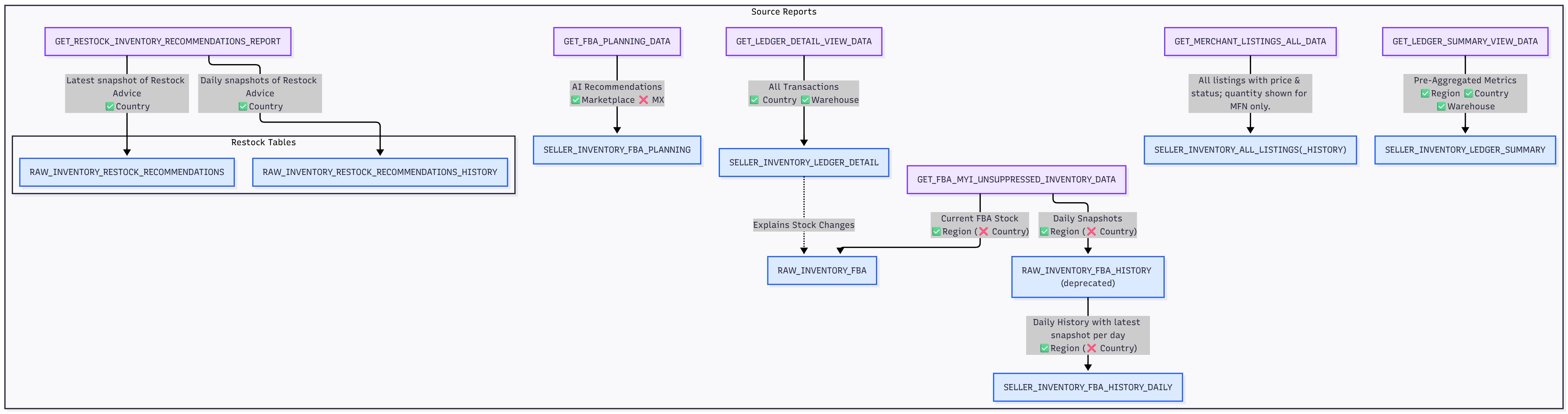
Practical Scenarios & Example Queries
Everyday FBA stock questions
"What's my current FBA stock, and does Amazon recommend any action on it?"
Use SELLER_INVENTORY_FBA_PLANNING_LATEST — your default for FBA questions.
Key columns:
available— current sellable stockrecommended_action— Amazon's pricing/removal adviceinv_age_365_plus_days— units aged over 1 yearestimated_storage_cost— projected fee exposure
SELECT SNAPSHOT_DATE,ASIN, SKU, AVAILABLE, RECOMMENDED_ACTION, INV_AGE_365_PLUS_DAYS, ESTIMATED_STORAGE_COST
FROM SELLER_INVENTORY_FBA_PLANNING
WHERE SKU = 'X'
ORDER BY SNAPSHOT_DATE DESC;
"Which aged SKUs should I remove to avoid storage fees?"
SELECT SKU, INV_AGE_365_PLUS_DAYS, RECOMMENDED_ACTION, ESTIMATED_STORAGE_COST
FROM SELLER_INVENTORY_FBA_PLANNING_LATEST
WHERE INV_AGE_365_PLUS_DAYS > 0;inv_age_365_plus_days is not populated for US, DE, UK, FR, IT, or ES. For those marketplaces, use inv_age_366_to_455_days and inv_age_456_plus_days instead to capture the same "aged over a year" population.
"Amazon says restock, but I have inventory — what's going on?"
The likely explanation: what you're counting as "my inventory" is total units on hand, but Amazon's restock alert is based on available — sellable stock only. A SKU can have plenty of total inventory while very little of it is actually sellable, if a large share is tied up in transit, processing, or unfulfillable status.
First, check the breakdown in SELLER_INVENTORY_FBA_PLANNING_LATEST:
SELECT AVAILABLE, RESERVED_FC_TRANSFER, RESERVED_FC_PROCESSING, RESERVED_CUSTOMER_ORDER,
       UNFULFILLABLE_QUANTITY, INBOUND_WORKING, INBOUND_SHIPPED, INBOUND_RECEIVED
FROM SELLER_INVENTORY_FBA_PLANNING_LATEST
WHERE SKU = 'YOUR_SKU';
If RESERVED_FC_TRANSFER, RESERVED_FC_PROCESSING, or UNFULFILLABLE_QUANTITY account for a large chunk of the total, that's inventory that exists but isn't currently sellable — which explains the alert despite what looks like enough stock.
If available genuinely looks sufficient and reserved/unfulfillable doesn't explain it, check weeks_of_cover_t30: a low value means Amazon's recommendation is forward-looking — it's forecasting that your current stock won't cover projected demand, not claiming you're already out.
SELECT WEEKS_OF_COVER_T30, DAYS_OF_SUPPLY
FROM SELLER_INVENTORY_FBA_PLANNING_LATEST
WHERE SKU = 'YOUR_SKU';
Cross-check the actual alert in RAW_INVENTORY_RESTOCK_RECOMMENDATIONS.
Everyday FBM questions
"What products are active/inactive, and what's my current price per SKU?"
Use SELLER_INVENTORY_ALL_LISTINGS — your default for FBM/MFN questions.
SELECT SKU, PRICE, STATUS, QUANTITY
FROM SELLER_INVENTORY_ALL_LISTINGS
WHERE SKU = 'X';
Cross-channel questions
"What's my combined FBA + FBM available and total stock for this SKU?"
Use SELLER_INVENTORY — it blends both channels so you don't need to join manually.
SELECT ASIN, SKU, TOTAL_AVAILABLE_QUANTITY, TOTAL_QUANTITY, FBA_LISTING_EXISTS, FBM_LISTING_EXISTS
FROM SELLER_INVENTORY
WHERE SKU = 'X';
"Is this listing only on one channel?"
SELECT ASIN, SKU, FBA_LISTING_EXISTS, FBM_LISTING_EXISTS
FROM SELLER_INVENTORY
WHERE FBA_LISTING_EXISTS = 'No' OR FBM_LISTING_EXISTS = 'No';
When you need more than Planning or Listings
"Which SKUs need urgent restocking?"
Use RAW_INVENTORY_RESTOCK_RECOMMENDATIONS — the report Amazon uses specifically for stock alerts.
SELECT SKU, ALERT, RECOMMENDED_REPLENISHMENT_QTY, RECOMMENDED_SHIP_DATE
FROM RAW_INVENTORY_RESTOCK_RECOMMENDATIONS
WHERE ALERT IN ('low stock', 'no stock');
Two things worth knowing:
- Planning has a parallel signal.
recommended_action = 'GoToRestock'withrecommended_ship_in_quantity/recommended_ship_in_datecan carry similar guidance. - SKU missing from this report? It likely means Amazon doesn't currently flag it as at-risk — no recent sales, healthy days-of-supply, or no projected demand are the usual reasons.
"Which FNSKU is linked to each ASIN/SKU?"
FNSKU isn't exposed on SELLER_INVENTORY_FBA_PLANNING_LATEST, SELLER_INVENTORY_ALL_LISTINGS, or the unified SELLER_INVENTORY view (see the known gap note on the unified view's page). It is available on RAW_INVENTORY_RESTOCK_RECOMMENDATIONS, even though that table's primary purpose is restock alerts, not identifiers.
SELECT ASIN, FNSKU
FROM RAW_INVENTORY_RESTOCK_RECOMMENDATIONS;
"Why did my inventory drop by 200 units in a specific country/warehouse last week?"
Planning gives you marketplace-level current state, not the transaction-level reason for a change. For that, use the ledger.
SELECT EVENT_TYPE, QUANTITY, FULFILLMENT_CENTER, DATE
FROM SELLER_INVENTORY_LEDGER_DETAIL
WHERE SKU = 'X'
  AND COUNTRY = 'US'
  AND DATE BETWEEN '2023-10-01' AND '2023-10-07';
"What's my net inventory change across all warehouses this week?"
Same idea, but you just want the aggregated net change — not every individual transaction.
SELECT COUNTRY, FULFILLMENT_CENTER, STARTING_WAREHOUSE_BALANCE, ENDING_WAREHOUSE_BALANCE
FROM SELLER_INVENTORY_LEDGER_SUMMARY
WHERE DATE BETWEEN '2023-10-01' AND '2023-10-07';Amazon DataHawk Reports
DataHawk Reports provide curated, business-ready datasets designed for reporting, analytics, and executive decision-making.
FBA Inventory Planning Data
Reference for SELLER_INVENTORY_FBA_PLANNING_LATEST, DataHawk's daily FBA inventory health snapshot covering stock, aging, velocity, and Amazon's recommendations.