
Keyword Research & Search Volume
Use DataHawk keyword research, lookup, and Amazon search volume data to find opportunities, prioritize terms, and understand demand.
Keyword data in DataHawk combines recommendations, observed ranking signals, and real Amazon demand data. Use this page to decide which keywords to track, which opportunities to prioritize, and how to read search volume once tracking begins.
What this area covers
| Dataset | What it tells you | Best for |
|---|---|---|
| Keyword Suggestions | AI-generated keyword ideas for tracked products | Finding new organic or paid keyword opportunities |
| Keyword Lookup | Keywords where your products ranked organically in the past 7 days | Understanding your current organic footprint |
| Keyword-Seeded Suggestions | Related keywords from a seed keyword | Researching a market before tracking a product |
| Keyword Placement | Historical listing keyword placement context | Legacy table analysis |
| Search Volume | Real Amazon demand for tracked keywords | Prioritizing high-demand terms and seasonality |
Keyword research datasets
Keyword Suggestions
AI-generated keyword ideas for your tracked products, refreshed daily. DataHawk analyzes your competitors, extracts the keywords they rank for, filters out irrelevant terms (brand names, sizes, colors), and scores what remains by relevance and opportunity.
Each suggestion includes:
- Competitivity Score (–100 to 100): How your product compares to the top 3 ranked products for that keyword, based on reviews, ratings, and price. A positive score means you are well-positioned to compete.
- Monthly Reach Potential: Combines search volume with the competitivity score to indicate how much traffic you could realistically capture.
Keyword Lookup
A weekly view of every keyword where your products ranked organically in the past 7 days, as detected by DataHawk's tracking system. Useful for understanding your current organic footprint.
Keyword-Seeded Suggestions (available on request)
If you don't have a product to start from, you can enter a seed keyword and DataHawk will surface related and adjacent keywords from its database. Reach out to your DataHawk contact to enable this.
Keyword Placement
Keyword placement is part of the historical keyword research table family. Collection has been paused since August 2023, so use it only when you need legacy placement context.
Search volume
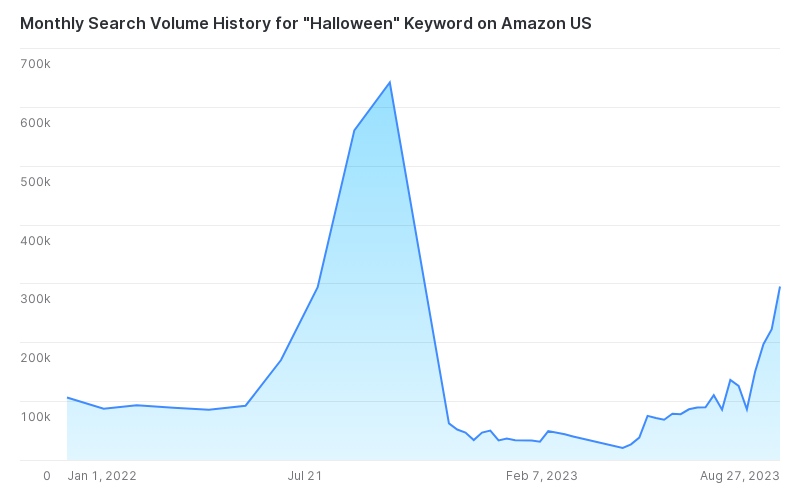
DataHawk provides real Amazon search volume for every keyword you track, sourced from Amazon's Search Terms Performance report and refreshed weekly. This gives you a historical view of how demand for any keyword evolves over time for each marketplace, using actual Amazon signals rather than estimates.
Use search volume when you want to:
- Track keyword popularity and seasonality
- Identify high-volume keywords for organic SEO and paid advertising
- Measure whether a campaign or listing change moved keyword demand
- Validate whether there is enough search demand before launching a product or entering a category
Each keyword variation is counted separately. For example, "bag" and "bags" are treated as two distinct keywords, each with their own volume. Keep this in mind when comparing keywords or summing volumes across a set.
Requirements and coverage
Keyword research and search volume have different availability rules.
| Area | Requirements and coverage |
|---|---|
| Keyword Suggestions | Works for approximately 90% of tracked products. Currently available for English-speaking marketplaces only: US, GB, CA, AU, SG, IN, AE. Track products before noon UTC to see updated results the following day at 6am UTC. |
| Keyword Lookup | Requires products and keywords to be tracked so DataHawk can observe organic ranking signals. |
| Keyword-Seeded Suggestions | Available on request. Reach out to your DataHawk contact to enable this dataset. |
| Search Volume | Requires the keyword to be tracked in DataHawk. Volume data does not backfill; collection starts from the day tracking begins. |
Search volume is supported in these regions:
| Region | Coverage |
|---|---|
| North America | All marketplaces |
| Far East | All marketplaces |
| Europe | Spain, United Kingdom, France, Netherlands, Germany, Italy, Sweden, Turkey, United Arab Emirates, India |
Search volume data available from:
- Most marketplaces: 1 May 2024
- AE and SG: 15 August 2024
Available dashboards
Keyword search volume is included in:
What to do if keyword data is missing
For keyword suggestions, DataHawk needs two types of context about your product: its browse node category and keyword ranking data. If either is thin, suggestions will be sparse or absent.
To build up that context:
- Refine your product's category assignment so DataHawk can identify the right competitive set
- Track more keywords relevant to the product - as your product accumulates ranking data, suggestion quality improves
For search volume, first confirm that the keyword is tracked. If it was added recently, remember that volume data starts from the tracking date and does not backfill historical periods.
Technical reference
Need keyword table names, refresh cadence, search-volume grain, or rank-table guidance?